Today’s post is a little self-indulgent, because I want to tell you a brilliant story about craft, maths and genius.
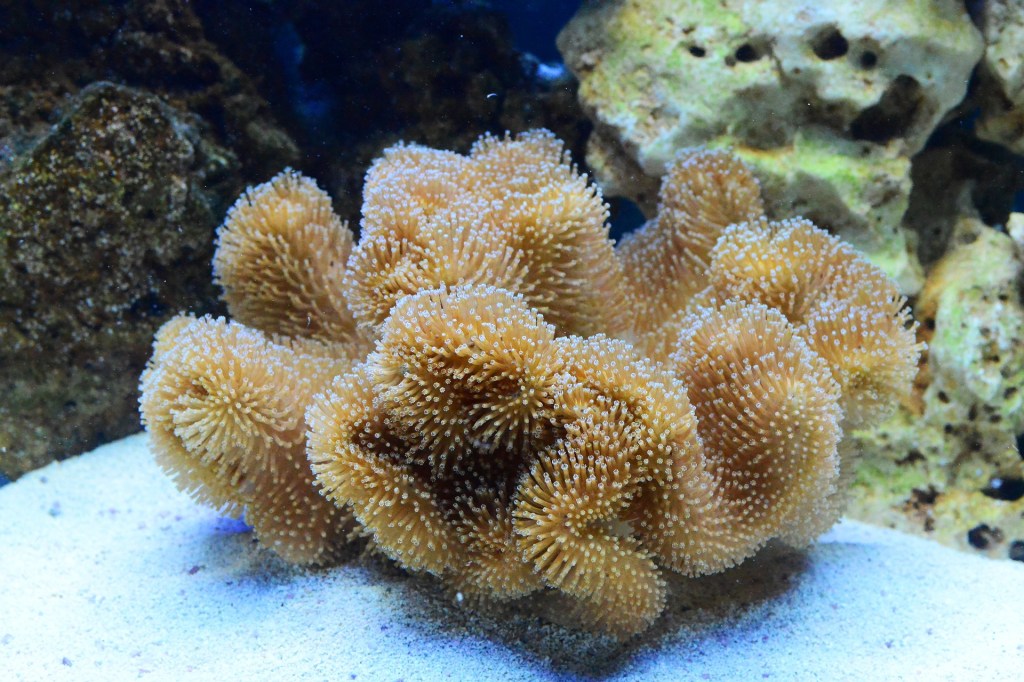
In 1997, a Latvian maths professor called Daina Taimina was taking part in a geometry workshop at Cornell University. A hyperbolic plane was being modelled using strips of paper delicately stuck together in a temporary, crumpled structure. What is a hyperbolic plane you ask? Good question. It’s a surface which curves away from itself at every point. A classic example of this in nature is the brightly-coloured, ruffled coral leaf. But despite its natural occurrences, mathematicians had failed since the 19th century to model hyperbolic space instructively.
Taimina had studied hyperbolic space before and, by her own admission, had struggled to understand it. But when she saw the flimsily-constructed paper model at the front of the workshop, she recognised the shape as something that she could replicate using a skill nurtured in her childhood: crocheting. That summer, she set about crocheting a host of hyperbolic forms, armed with just her yarn and crochet hooks. She crocheted in rounds, increasing exponentially as she went, reaching rows which took many hours to complete.
The results were extraordinary. Her models – substantial, malleable, durable – were the perfect model for studying and visualising hyperbolic space. Lines could be stitched across them to observe features of the plane. Diagrams that had been largely incomprehensible in two dimensions were rendered much more accessible when demonstrated on her crocheted models. It was a revolution in non-Euclidean geometry.
What does this have to do with data science? More than it might seem. I bring it up not only because it’s a terrific tale and because I myself am keen on crocheting (though hats, scarves and Star Wars characters are my purview). I bring it up because I’ve just read a marvellous book by Caroline Criado Perez called Invisible Women: Exposing Data Bias in a World Designed for Men. She uses this story to illustrate a simple but important point: asking women yields results.
This is a pattern that I am noticing as I read around my new field: the paramount importance of including a diversity of people in all collection, analysis and utilisation of data. It is essential if we seek to eliminate bias, foresee shortcomings and come up with innovative solutions. Invisible Women is a comprehensive study of how the exclusion of women in data has been detrimental to us all. We can similarly look to the realms of Artificial Intelligence to observe how, worryingly, machines are inheriting human biases and prejudices from insufficient and unbalanced training. Not all data is equal.
But more on that another time. For now I feel an urge to crochet some non-Euclidean space…
 Cryptic Meg