The Whalebone Theatre – Joanna Quinn

This was an e-reader daily deal I picked up. The blurb appealed to me:
Cristabel Seagrave has always wanted her life to be a story, but there are no girls in the books in her dusty family library. For an unwanted orphan who grows into an unmarriageable young woman, there is no place at all for her in a traditional English manor.
But from the day that a whale washes up on the beach at the Chilcombe estate in Dorset, and twelve-year-old Cristabel plants her flag and claims it as her own, she is determined to do things differently.
This seemed to tick several boxes for me: feminist, set in the 1920s, and set in a big country house (enough to quicken my Brideshead-loving pulse). The reviews were all tremendously positive, describing the book as having the makings of a classic.
But.
It took me over two weeks to read. It was immensely long, and, to my mind, dullll. The writing was good (the author has a particular knack for onomatopoeia!), and I liked the way that the theme of the theatre was revisited throughout. But it was unbearably, frustratingly slow. I became so irritated with the glacial pace of it that I lost empathy for the characters, and was simply relieved to finish it. I persevered because the quality of the writing gave me hope that it might all be worth it in the end. It wasn’t.
I recognise that this is at least partially due to personal taste: it wasn’t really a book about the 1920s, or about a country house. These set the scene for a book about the Second World War. This is not a topic of particular interest to me.
I was hoping to be able to draw out parallels with Brideshead Revisited, but alas, there were few. There was this passage:
“I’m telling you, Rosalind, spend a weekend at an English country house and you die a thousand deaths. The longest hours of your life spent sitting waiting for someone to bring you a cocktail. Of course, when they finally do arrive, holding your drink and wearing a well-cut Savile Row suit, you fall desperately in love with them. Because what else is there to do? Why else do we go to these big houses with their infinite lawns? All these perfectly manicured empty spaces – they demand we find some way to fill them, some meaning to justify the empty hours.”
The Whalebone Theatre – Joanna Quinn
… which made me think of Sebastian’s dismissal and dislike of the house, and his dependence on alcohol.
There was also:
In other valleys and villages, other houses, much the same. Unaffordable manors left bare, heirless; hollow mausoleums.
The Whalebone Theatre – Joanna Quinn
… which I thought was a rather lovely description of the decline of the English country house. And:
She was, she felt, somehow anti-future. It did nothing, as far as she could work out, but grip too tightly on the present.
The Whalebone Theatre – Joanna Quinn
… which is practically a remix of a quote from Julia in Brideshead: “Sometimes, I feel the past and the future pressing so hard on either side that there’s no room for the present at all.”
Once Upon a Time in the East – Xiaolu Guo
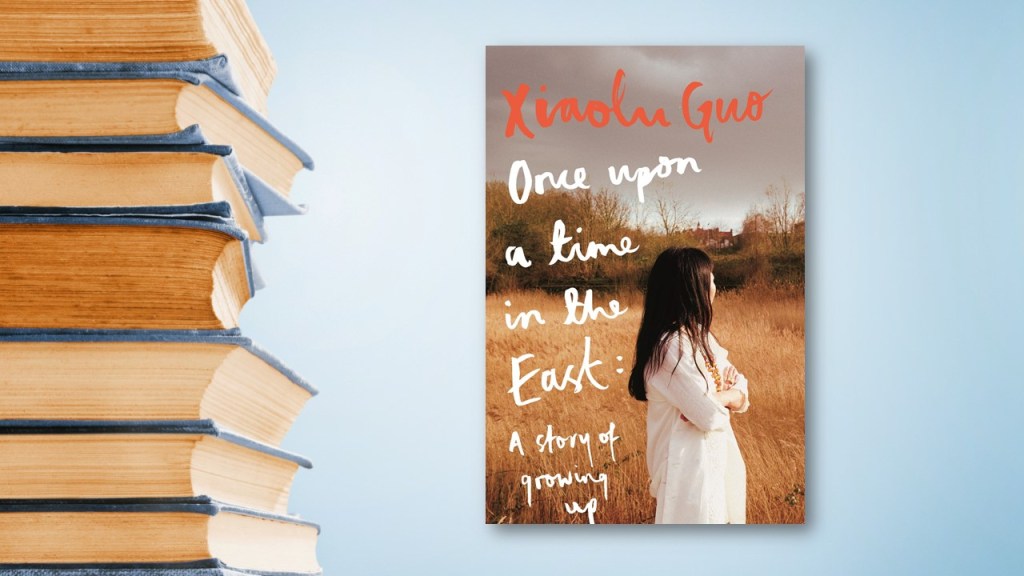
This was this month’s book group read. It is the true story of Xiaolu Guo’s childhood in rural China, her time at university in Beijing, and her subsequent career as a writer and film-maker in the UK.
My goodness, did I struggle with this. It took me much longer than it should have done to finish, because I found it drainingly depressing. The author has simply had a horrible time of it everywhere she has lived. The book was well written, and I learned a tremendous amount about Chinese history and culture (a huge blind spot for me previously), but it was completely devoid of joy. I have a lot of respect for the author, having lived through it all and being able to write about it so matter-of-factly: I never got the impression that she was being emotionally manipulative or trying to garner sympathy. In her childhood alone, she experienced abandonment, poverty, hunger, a family suicide, sexual exploitation, an abortion, and a complete absence of love and kindness.
I only persevered with the book out of a sense of obligation: partially because I was reading it for book group, and partially because the author actually lived through all this misery – the least I could do was read it. But there were parts that left me staring vacantly into space, dumbly grappling with the horror of what I had just read.
Does it help us to read these sorts of accounts? I am in two minds about this. On the one hand it educates me about others’ experiences and fosters empathy. On the other hand, I feel entirely powerless to effect any meaningful change. Doubtless there are children all over the world who are having as terrible a childhood as this author had – and I am left feeling miserable that there is not a thing I can do about it. The best I think I can do is learn from her experience of coming to the UK (where she had a very solitary beginning), and do what I can to be welcoming of people who have come here seeking a better life.
Stolen Focus: Why You Can’t Pay Attention and How to Think Deeply Again – Johann Hari
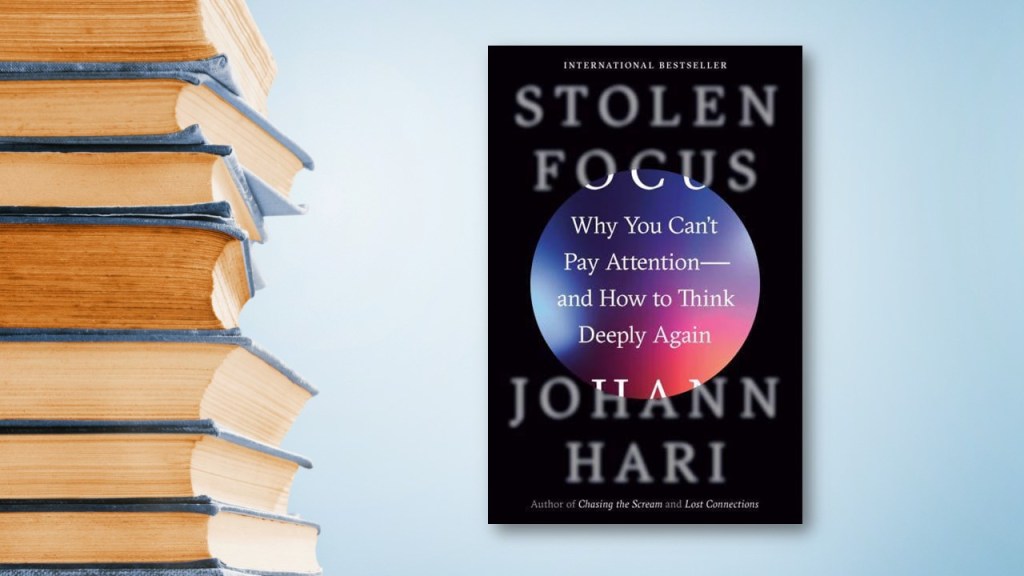
This was an e-reader daily deal I picked up, because I have long been aware of my attention span shrinking, a phenomenon I have laid at the door of social media in particular. I have consequently tried to limit my social media use, and tried to improve my focus (through my reading renaissance, for example!).
The book was brilliant. It was fascinating, terrifying, and energising. I started off highlighting a lot, and then gradually ceased because I found myself wanting to highlight the whole book!
Everything about this made so much sense to me. The reasons for our decreasing attention all relate to modern life: its stresses, its exhaustion, its pressure to be productive, its addictive technology, and the collapse of relaxation, deep focus, play and mind wandering. But (and this also made sense to me): this is not a self-help book. The author had a few tips, but the main thrust of the book was that these problems are systemic, and require enormous collective changes. The onus cannot be solely on the individual to improve their attention when their attention has been eroded by sweeping aspects of modern society.
We need change. We should advocate for it and demand it. Humanity is facing its great challenge in the climate crisis, and we need every ounce of attention we can reclaim in order to solve it. I would recommend this book to anyone, because I think its message is so important.
The Perfect Golden Circle – Benjamin Myers
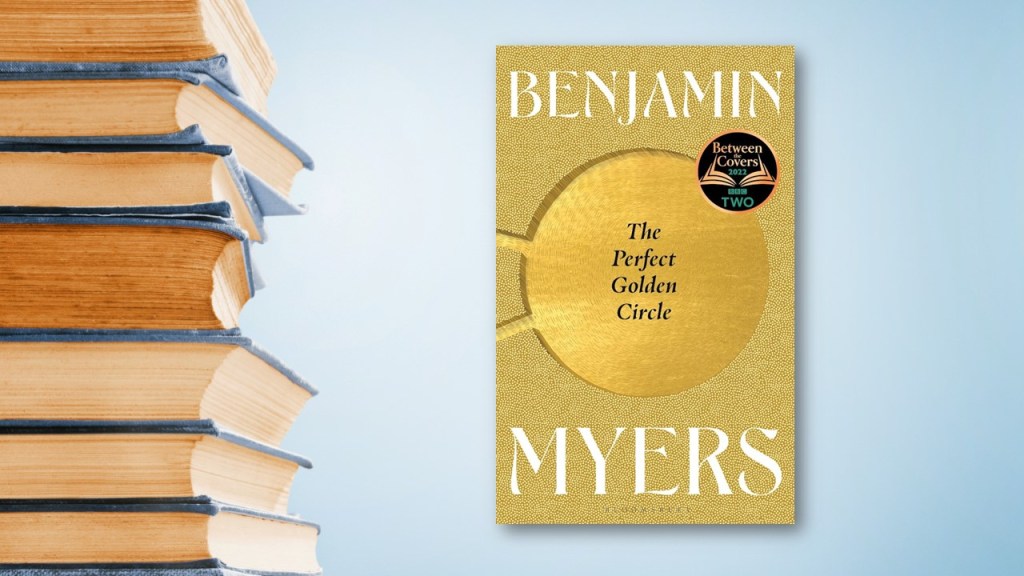
This was recommended to me by my friend Lucy. In a rare turn of events, I actually purchased the e-book at full price!
The concept was intriguing. Throughout the summer of 1989, two men meet under cover of darkness to create intricate crop circles. Each chapter takes a different night, a different crop circle. The interactions between the men end up forming a social commentary about class, trauma and the countryside, amongst other themes.
There was a lot about this book that was very beautiful, including the poetic prose in praise of the countryside, and delicate and careful construction of characters. It was a slow read, however, with little more in the way of plot than outlined above. And what I would have loved to have seen was illustrations of the crop circles; as it was, I struggled to imagine them!
My favourite quote, outlining the men’s mission and saying much about art, was this:
He knows that their crop circles are fleeting and superficial, all surface, and quite useless, in a way, but he also knows that they matter because they are beautiful and nothing truly beautiful can be useless. It has taken him three summers… to reach this revelation: that their beauty is their very purpose, and in just a matter of weeks they will no longer exist in the topsoil, in the barley and the wheat; they will no longer be visible from hill or helicopter, but instead will be one more story pressed down into the stratum.
The Perfect Golden Circle – Benjamin Myers
Somewhat bizarrely, the book of which I was reminded most strongly was a childhood favourite: The Owl Who Was Afraid of the Dark by Jill Tomlinson. Each night, the little owl meets someone new who tells him something new about the dark. In The Perfect Golden Circle, the two men are interrupted most nights by people who reveal something about the state of society in 1989 (the themes are rather more adult!).
I was also reminded of one of the themes in Stolen Focus, in this section about a pond:
Once… local children would come to swim and frolic, but now it is fenced off to the world, and no children swim or frolic here. Their anxious-eyed parents, city-born transplants into the growing suburbs, have filled them with a trepidation for their natural surroundings and pumped them plump with horror stories. The parents prefer to keep them within sight now. Fresh fears have replaced traditional ones, and a different sense of policing takes place now, though it is all grounded in an intolerance for the unknown.
The Perfect Golden Circle – Benjamin Myers
In Stolen Focus, the author talks about how children no longer play freely. Parents’ fears are completely understandable: the modern-day news cycle exposes us to many more terrible events than we would have been aware of in decades past, and it causes us all to operate under the psychological fallacy that such events are much more likely than they actually are. But children, and all of us, lose out by not being able to play, by not being able to explore, and by being afraid of the natural world.
 Cryptic Meg