The Heart Goes Last – Margaret Atwood
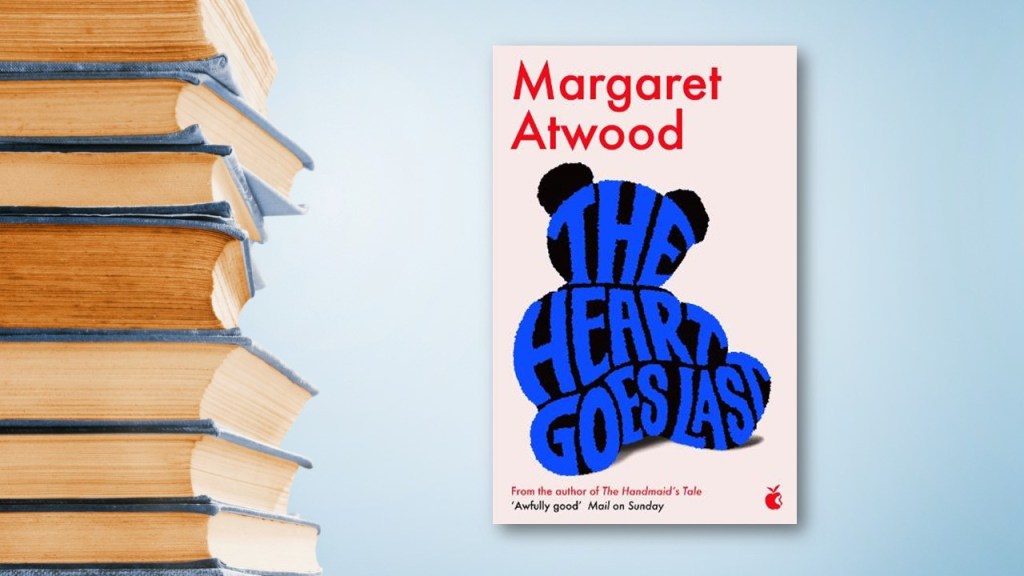
I picked up this book at Heathrow Airport, on my way to Gothenburg. I had a lot of time to kill before my flight, so I had a poke around the bookshop, not particularly intending to buy anything because I’d stocked up on a few options on my e-reader. Suddenly I had a nostalgic memory of flying for the first time when I was six years old. At the airport I picked out The BFG by Roald Dahl, which my parents bought me and I read on the plane. Now, flying alone for the very first time, I thought I would treat myself to another airport book.
I browsed the A-Z fiction section of the shop. I was gratified to recognise a lot of authors – my reading renaissance over the last couple of years having covered quite a breadth of material. It was nice to be able to hone in on authors I liked – which is how I came to Margaret Atwood’s section of shelf (having enjoyed The Handmaid’s Tale and The Testaments).
The Heart Goes Last was no disappointment. Another dystopia (I’m starting to think this is my genre), in a near-future world plagued by unemployment and poor access to amenities. A social experiment has been proposed: a town where half the population live in a suburban paradise, and half live in a prison. Each month, the two cohorts swap places.
I was gripped by the concept and Margaret Atwood’s brilliant writing. It should come as no surprise that everything turned very dark – the reason for the title is bleak, and background to the blue bear on the front of my edition is particularly horrifying. It’s not for the faint of heart.
— Content warning: sexual assault —
I am always interested in depictions of AI in fiction, so I took particular note of the portrayal of humanoid sex robots in The Heart Goes Last. These are not presented as having any kind of consciousness (as yet), as bleakly revealed in this extract:
But it won’t be anything like the real thing, say the detractors: you won’t be able to look into their eyes and see a real person looking out. Oh, they’ve got a few tricks up their sleeves, say the boosters: improved facial muscles, better software. But they can’t feel pain, say the detractors. They’re working on that feature, say the boosters. Anyway, they’ll never say no. Or they’ll say no only if you want them to.
The Heart Goes Last – Margaret Atwood
As ever, the way that humans treat human-mimicking machines – conscious or not – can reveal deeply uncomfortable truths about how we could treat our fellow man, given permission. I was reminded of the TV series Humans, in which a “synth” (a humanoid robot) is working in a brothel, and ends up killing a client who asks her to act young and frightened. He doesn’t know that she is a conscious synth (an aberration in the Humans universe), but she recognises his fantasy as deeply problematic regardless.
It’s a profound question beyond the fictional realms. We already have voice assistants in our homes, predominantly replicating female human voices. Is the way we speak to them informed by our perceptions of women? Will it affect how we treat human women – making demands of them? These are difficult questions. On the one hand, play-acting behaviour does not necessarily engender that behaviour in real life (for example, playing violent video games does not make people more violent). But if the play-acting is informed by a pre-existing world view, perhaps it has more clout…
I’ll leave you with this troubling sentence:
Maybe all women should be robots, he thinks with a tinge of acid: the flesh-and-blood ones are out of control.
The Heart Goes Last – Margaret Atwood
— End of content warning —
The Island of Missing Trees – Elif Shafak
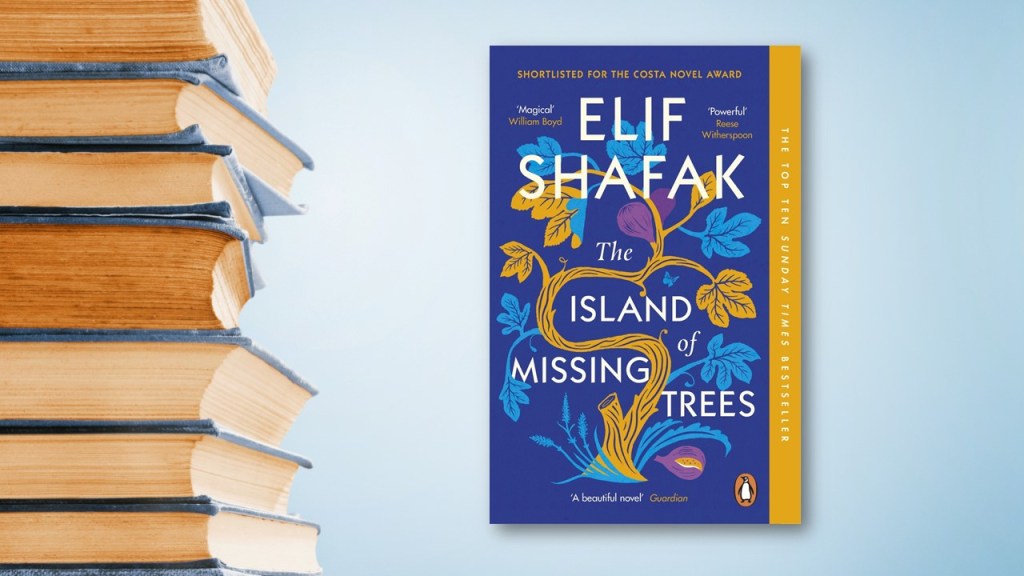
This was this month’s book group read. I started reading the book and then switched to the audiobook (as I often do with book group, to finish in time!). This was probably a mistake, as I found one of the voices narrating the audiobook intensely irritating. But it did help with the Cypriot pronunciations!
The book has strands in a couple of different times: the story of Ada, a teenager struggling with grief in modern-day London, and the Romeo and Juliet story of her parents falling in love in divided 1970s Cyprus.
It was a popular book at book group. We particularly enjoyed the themes of nature, history and food (food being a central part of our book group experience – everyone did a fantastic job of making some of the mentioned Cypriot dishes for the occasion!). I felt that the character development was particularly strong – I found the anxious Ada disconcertingly believable. But I was less convinced by some of the plot devices, which was a common criticism in the group. A lot of strange things happen or are alluded to without ever being mentioned again, and we were left a little baffled as to their purpose.
Many of the chapters are, interestingly, told from the point of view of a fig tree. I found this particularly intriguing, being interested in artificial intelligence and intelligence generally. Plant intelligence is another very curious possibility! The following section was particularly fascinating (and reminded me of the excellent David Attenborough series Green Planet, which addresses the idea of plant intelligence):
My guess is humans deliberately avoid learning more about us, maybe because they sense, at some primordial level, that what they find out might be unsettling. Would they wish to know, for instance, that trees can adapt and change their behaviour with purpose, and if this is true, perhaps one does not necessarily depend on a brain for intelligence? Would they be pleased to discover that by sending signals through a network of latticed fungi buried in the soil, trees can warn their neighbours about dangers ahead – an approaching predator or pathogenic bugs – and such stress signals have escalated lately, due to deforestation, forest degradation and droughts, all of them caused directly by humans? Or that the climbing wood vine Boquila trifoliolata can alter its leaves to mimic the shape or colour of those of its supporting plant, prompting scientists to wonder if the vine has some kind of visual capability? Or that a tree’s rings do not only reveal its age, but also the traumas it has endured, including wildfires, and thus, carved deep in each circle, is a near-death experience, an unhealed scar? Or that the smell of a freshly mown lawn, that scent humans associate with cleanliness and restoration and all things new and zestful, is in fact another distress signal issued by grass to warn other flora and ask for help? Or that plants can recognize their kith and kin and feel you touching them, and some, like the Venus flytrap, can even count? Or that trees in the forest can tell when deer are about to eat them, and they defend themselves by infusing their leaves with a type of salicylic acid that helps the production of tannins, which their enemies detest, thus ingeniously repelling them? Or that, until not that long ago, there was an acacia in the Sahara desert – ‘the loneliest tree in the world’, they called it – there at the crossroads of ancient caravan routes, and this miracle of a creature, by spreading its roots far and deep, survived on its own despite the extreme heat and lack of water, until a drunk driver knocked it down? Or that many plants, when threatened, attacked or cut, can produce ethylene, which works like a type of anaesthetic, and this chemical release has been described by researchers as akin to hearing stressed plants screaming?
The Island of Missing Trees – Elif Shafak
Emotively told, this section nonetheless imparts real science. It poses huge questions (with parallels for the field of AI) about how we define intelligence, sentience and consciousness. I am far from having all the answers, but I’m very interested in the questions.
Blind Faith – Ben Elton
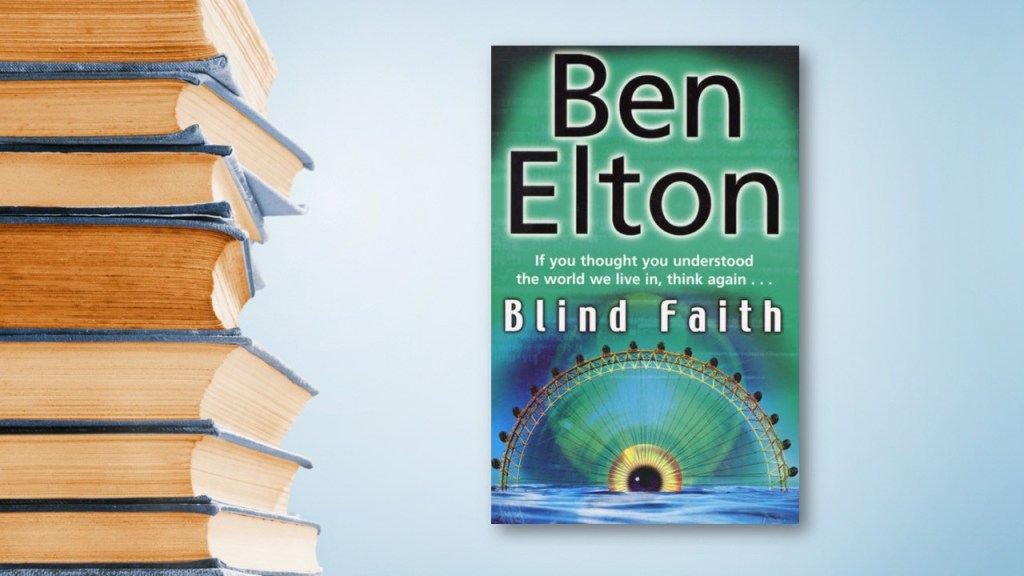
I was wandering around the house trying to find my next book to read, when I stumbled upon this in our sci-fi section. Nicholas had been given it several years ago by a colleague: a Religious Studies teacher who also happened to be an atheist. As a Christian, Nicholas had a lot of thought-provoking conversations with her about religion. I waved the book at him and asked, “would I like this?”. He scrunched up his face and replied, uncertainly, “well… it is a dystopia…”
The book is set in London, in a future world which has been largely flooded due to global warming. Religious faith is compulsory and science is rejected. Privacy is considered morally repugnant: everyone constantly shares intimate details of their lives online, and are considered highly suspicious and “perverted” if they do not. Our main character is Trafford – a man who secretly thinks that privacy might be a good thing. In an anti-vax world with sky-high infant mortality rates, he is offered the covert chance to vaccinate his baby daughter. The plot follows from there.
I found that it was a book of two halves. In the first half very little happened; the author was simply setting the scene. And goodness me, was it an unappealing scene. There is a great deal of focus on bodies: because the world is now very warm, people wear extremely little clothing. And because everyone is expected to share everything online, there is very open discussion and depiction of sex. This would have been fine as a concept – but the first half of the book just seemed to be obsessed with sex and naked bodies, to the exclusion of other themes. The vaccination story and the much more interesting things which follow are confined to the second half of the book, and therefore not really given enough space. I felt that it had the foundations of an interesting dystopia, but it lacked conceptual integrity because it was laser-focused on a couple of disjointed themes.
I also felt that this wasn’t an insightful take on religion. The religious leaders in the book are ludicrous. They represent an extension of the furthest extremes of our real-world religions, bearing no resemblance to the billions of real-world faithful. As a Christian, I didn’t feel critiqued. Nothing in the book looked remotely like my religious practice. All I could see was a daft dictatorial culture which wasn’t actually informed by faith (they spout adages about “the Love”, “baby Jesus” and “Diana”, but never anything more substantial). One could come up with much more believable religious tyranny!
I’ll take some Blackadder instead thanks, Mr. Elton.
 Cryptic Meg