Bewilderment – Richard Powers
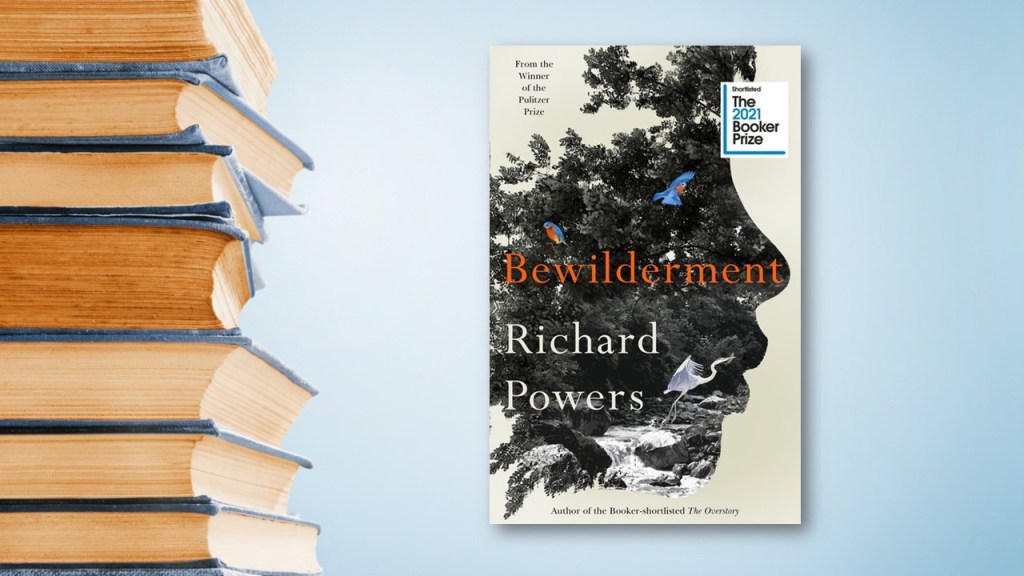
This was this month’s book group read. It is written from the point of view of Theo, an astrobiologist, recently widowed and coping with the difficult behaviour of his nine-year-old son Robin. It covers a lot of themes: the possibility of alien life, the climate crisis, politics, scientific research, parenting, mental health, grief, experimental therapy…
It was a book which greatly intrigued me. I’ve never read anything like it. The diverse themes were fascinating, and the language could be quite beautiful. I should have loved it – working in scientific research myself, and being very concerned about the climate crisis.
I didn’t love it.
*** Vague spoiler alert ***
The major problem was the plot. This was actually incredibly simple: something happens, and is then undone. It was slow, but at least had a pleasing symmetrical arc. That was the case anyway, until the final five pages. I suppose I have to respect a book that makes me say “Oh my word!” out loud – the ending certainly had shock factor. But there wasn’t any chance at all to process the twist, to understand its purpose. It could have been such a powerful event had it been explored and the aftermath shown. As it was, I was left reeling – just stunned, without resolution.
Resolution was a general problem here. After the shock ending it took me a while to process that there had been many little mysteries left unsolved, mainly surrounding the mother. How did she really die? Did she have an affair? Is Robin really Theo’s son? Don’t get me wrong – I don’t need everything tied up in a neat bow. I love a lack of resolution with a purpose (e.g. the glorious mystery of Cold Comfort Farm – what was in the woodshed?!). But here the mysteries served a purpose that was beyond my grasp. They seemed primarily gossipy doubts – tainting the memory of a beloved wife and mother in ways that were incongruent with how she was otherwise presented.
*** End of vague spoiler alert ***
Viewing the book through an academic lens (which I think is fair enough, given that there was a lot of scientific research mentioned here), I think it is quite unforgivable that the author didn’t cite his sources, or provide any acknowledgement of what was fact and what was fictionalised. I was highly sceptical about the feasibility of “Decoded Neurofeedback”, the experimental therapy that Theo’s son undergoes – but it turns out that this is quite real! Perhaps all the science referenced in the book was accurate (though given that this is set in the near-future, some must have been at least extrapolated). Even so, it is the author’s duty to provide their source material: to allow readers to check the facts/do further research, and to provide credit where credit is due.
Now, onto one of my usual favourite themes: intelligence (artificial or otherwise). Given there was quite a lot of focus on the possibilities of alien life, there were a few extracts that were of interest to me. Such as this thoughtful reflection:
Trouble is what creates intelligence?
I said yes. Crisis and change and upheaval.
His voice turned sad and wondrous. Then we’ll never find anyone smarter than us.
Bewilderment – Richard Powers
There was also this on the potential of machines to augment our intelligence (the context is the idea of the Great Filter – that becoming intelligent interstellar lifeforms requires an improbable stage of evolution):
Maybe the Great Filter isn’t behind us. Maybe it’s ahead of us.
And maybe we were just now hitting it. Wild, violent and god-like consciousness, lots and lots of consciousness, exponential and exploding consciousness, leveraged up by machines and multiplied by the billions: power too precarious to last long.
Bewilderment – Richard Powers
And finally there was this section about the possibility of digital life on another planet, which made me think of the rather lovely episode of Black Mirror: “San Junipero”.
What is it?
“It’s a computer server farm.”
What happened to everyone, Dad? Where did the people go?
“They’re all inside.”
My son frowned and tried to picture: a building of circuitry, infinitely bigger on the inside than on the outside. Rich, unlimited, endless, and inventive civilizations – millennia of hope and fear and adventure and desire – dying and resurrecting, saving and reloading, going on forever, until the power failed.
Bewilderment – Richard Powers
Lovely writing, as you see! And fascinating concepts. I just didn’t think it was well built as a story.
Dune – Frank Herbert
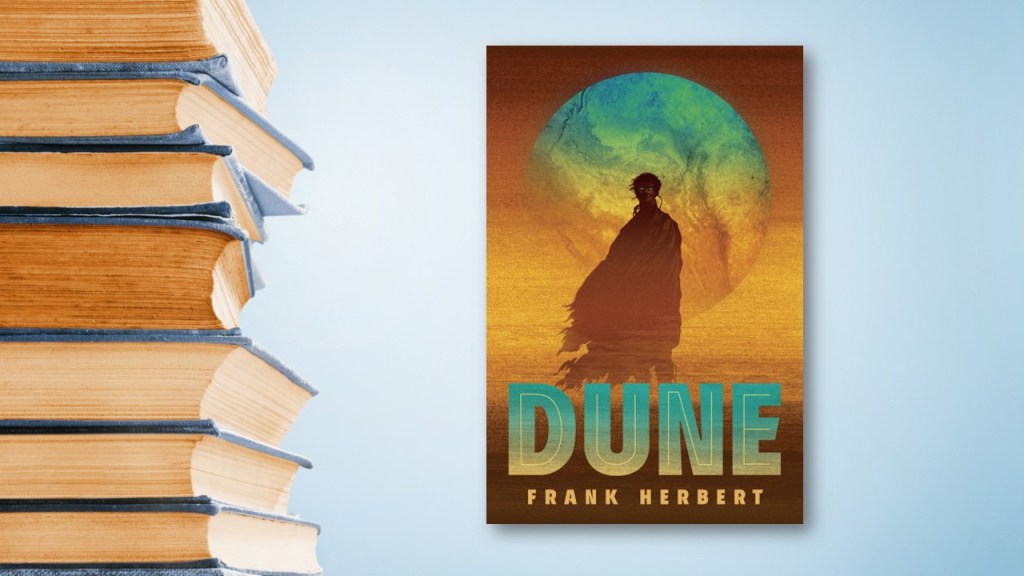
This (the entire trilogy, in fact) was an e-reader daily deal. I had a certain amount of apprehension about reading it: I generally avoid space odyssey sci-fi books as I suffer from a chronic lack of imagination. It’s also pretty long! However, it had a lot to recommend itself to me. It’s a classic, my husband has read it and enjoyed it, I enjoyed the film of Dune: Part One, plus I had recently seen the trailer for Dune: Part Two (and wanted to remind myself of the preceding plot in preparation).
The first thing I would say is: don’t read this as an e-book. With my preferred font size, I had paced myself for 1100 pages. I was quite shocked when the story ended after 850 – the rest was appendices and, to my frustration, a glossary. I had been so annoyed by the fact that I had kept looking up words that were not in the e-reader’s dictionary. Obviously, I should have thought to check for a glossary – but even if I had, I would have struggled to flick back and forth in the e-book. Hence my top tip: don’t read this as an e-book.
That said, let’s move onto the positives. What I enjoyed about this book was the world-building (quite unusually for me – see aforementioned lack of imagination). It is set on the planet of Arrakis – a planet covered in desert. The uniform arid landscape didn’t tax my imagination too hard, and what I was impressed by was the description of the native population – the “Fremen”. This was so consistent with their environment and made so much sense – everything about their culture is geared towards survival in this inhospitable climate. Water is prized above all else, and takes on a holy status.
With this appreciation for the context-setting, I started off enjoying the book more than I expected to. I didn’t find it oppressively dense, as some people have – the detail was mainly in dialogue rather than description which appealed to me, although I had to slow down to understand all the politics. I initially liked the characters, and was particularly struck by the importance and power of the main character’s mother, which I thought was admirable female representation for a sci-fi book written in 1965.
I plodded through the book contentedly enough, but became less convinced of its merits by the end. The main character became quite irksome, having realised his messianic role (which apparently brought with it pomposity as well as power). The mother character was much less important in the second half of the book, and in her place we were introduced to a main female character who disappointingly had no personality at all. Other interesting characters met abrupt and inauspicious ends.
Additionally, the writing style was not always to my taste. The book is written in the third person, but we get occasional insights into character’s thoughts. I find this breaks the narrative, jerking us from external spectator to internal confidant and back out again. It also removes subtlety – I think it’s much cleverer to “show me, don’t tell me” what a character is feeling.
I liked the book enough to persevere with it. But I didn’t like it enough to read the appendices, or, I think, to read the rest of the trilogy.
A Pocketful of Happiness – Richard E. Grant

This was another e-reader daily deal, which I would probably never have thought of reading otherwise. But I’m a fan of Richard E. Grant’s performance in Withnail and I (of course) as well as his appearances in things like Doctor Who and Star Wars. I was also aware, from social media, of the recent sad death of his wife from cancer.
These extracts from his personal diaries are remarkably well-written – my attempts at diary-keeping have not been nearly so witty, erudite, or joyful! He is clearly a committed diarist, and the result is a comprehensive and intimate insight into the last year of his wife’s life. There were also flashbacks to key moments in his career (which could read like a litany of famous names, but he is always delightfully star-stuck). I was far more interested in the long happy marriage he described, which in its character reminded me rather a lot of my own marriage!
We began a conversation in 1983 and we never stopped talking.
A Pocketful of Happiness – Richard E. Grant
His honest and raw account of his wife’s illness is incredibly touching, and I shed tears when he recounted her death. Not long before she died, she entreated him and their daughter to find “a pocketful of happiness” in every day. Hence the title of the book, and what a wonderful wish for them both.
Modeling Mindsets – Christoph Molnar
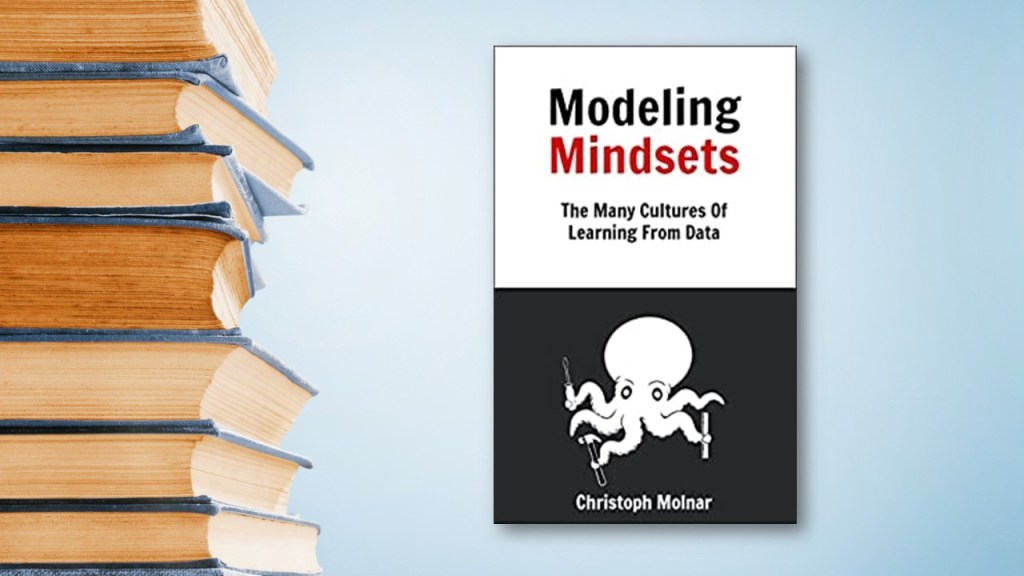
This was a book that my dad sent me. It’s relevant to my work – in my PhD I am building AI-based models to look at brain scans and predict whether or not a person has Parkinson’s. The book covers the different ways we can think about building anything that models nature like this. It was short, clear, and neatly organised. The “mindsets” fall broadly into two categories: statistical thinking and machine learning thinking. Being a machine learning person myself, I occasionally got a little lost in the statistical sections – but the author did well at keeping the text high-level and number-free. He encourages us all to know our own mindset in depth, but also to be aware of the other mindsets, because each has benefits to offer the others.
I particularly enjoyed a couple of moments of humour:
Statisticians do more than just statistical modeling. They visualize data, plan experiments, collect data, complain about machine learning, design surveys, and much more.
Modeling Mindsets – Christoph Molnar
A machine learner walks along the beach. He sees a bottle in the sand, opens it, and finds a genie who grants him a wish. “I want to understand all machine learning algorithms in the world,” he says. The genie nods. “Your wish is granted.” The machine learner disappears in a puff of smoke. In his place is a statistician.
Modeling Mindsets – Christoph Molnar
She’s In CTRL: How Women Can Take Back Tech – Anne-Marie Imafidon
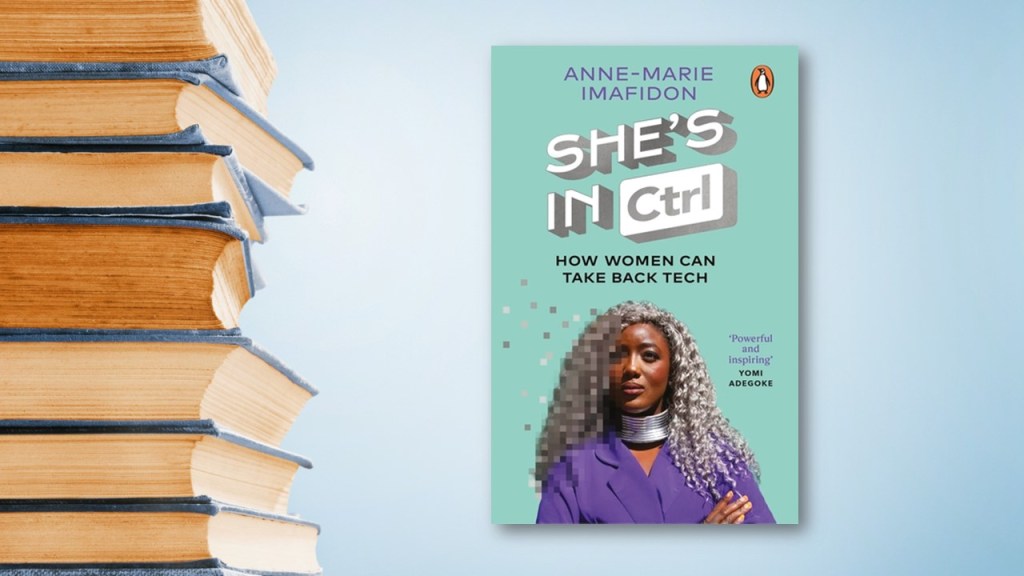
I’ve been keen to read this, as a woman in tech myself and a fan of Anne-Marie Imafidon (since I first saw her on the Royal Institution’s Christmas lectures in 2019). My expectations were high.
Unfortunately I don’t think this book was written for me. This was aimed more at women who are interested in tech, but are new to it and intimidated by it. The most basic technological concepts were explained, and most of the examples given were very familiar to me. This is all well and good, and I think it would be a great book for a tech novice. However, as an established techie with a degree/career in STEM already, I’m afraid I didn’t find this all that helpful. There were some stark (but unsurprising) statistics about the gender imbalance in tech, and some interesting examples of female tech entrepreneurs (I did discover a female-led app through the book which I am now using). But I didn’t find much in the book to help me continue my particular career in tech. A lot of the advice given was about influencing policy and being involved in high-level conversations, whereas I am at the coalface of technology – coding and researching and doing my best to avoid social situations – which is where I intend to stay. I found little in the way of practical advice for a person in my situation.
I did highlight a couple of encouraging excerpts:
Despite those challenges, the world of tech is a powerful place to be. It can be fulfilling, it can be creative and, ultimately, it can be altruistic. The reasons for wanting more women to enter the tech world vary, but for me, it’s about using technology ‘properly’ to better solve the problems of society.
She’s In CTRL: How Women Can Take Back Tech – Anne-Marie Imafidon
As you begin this journey – and it’s a lifelong journey – remember that it’s not about learning everything at once. Curiosity is your foundation. Asking questions is key. Having the self-awareness to say, ‘I won’t ever know it all, but I want to know a little bit more,’ will launch you on your way. And knowing a little bit more is better than knowing what you currently know.
She’s In CTRL: How Women Can Take Back Tech – Anne-Marie Imafidon
 Cryptic Meg