When I was thirteen, we read Holes by Louis Sachar at school. The teacher set us the task of mapping out on a piece of paper all the connections between characters, events, places, objects and themes. I thoroughly enjoyed this task – especially as Holes is so full of connections. (The teacher commented that I would probably like Great Expectations for this reason, but I still haven’t read it…)
This month I started to notice myself mentally mapping out connections between books in a similar way. It’s been a month quite heavy with dystopian fiction, but even outside of that genre I found my mind tugging at particular phrases or paragraphs that reminded me of other things I had read. I think this means that my reading renaissance has reached a pleasing stage: I have started to identify patterns, which I find tremendously satisfying. I shall try to bring some of those connections out in these reviews.
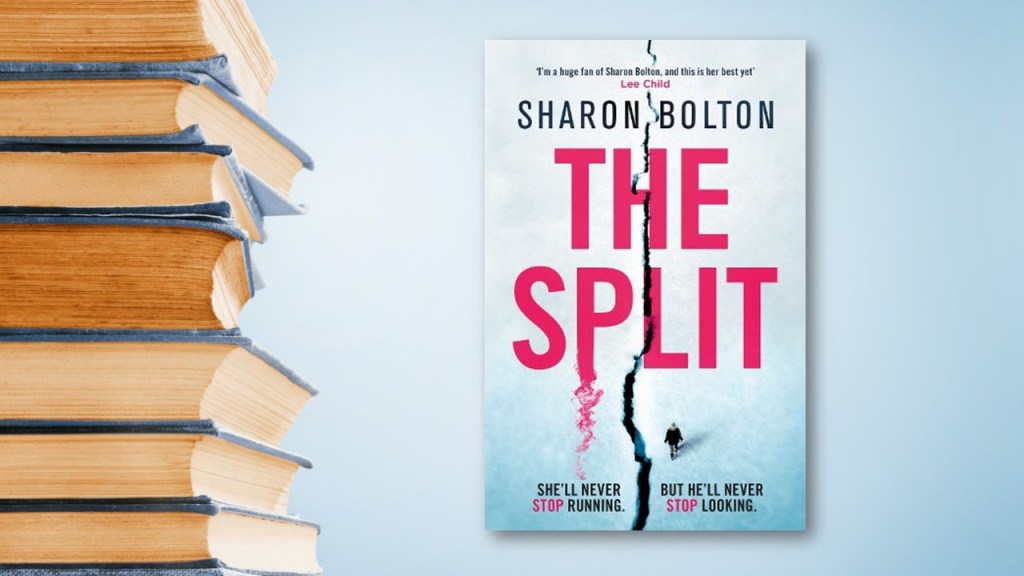
The Split – Sharon Bolton
I received this book in my book group’s Christmas “bran tub”: everyone wraps up a book they own that they’ve either been meaning to read, or think is particularly enjoyable. (I wrapped up Bookworm: A Memoir of Childhood Reading by Lucy Mangan, because it seemed appropriately bookish).
The Split is one of those books I would never have chosen for myself. It is crime fiction: a genre I have utterly ruined for myself by having worked for the police. I find myself picking holes in the investigations and failing to see the entertainment value. So naturally, I started reading this book with a critical eye.
It is difficult to say anything at all about The Split without spoilers, because it is full of twists and turns and misconceptions. The basic premise is that a glaciologist called Felicity has gone to South Georgia as part of her work, but also to flee a man called Freddie who is pursuing her. As the book progresses, a lot more about this game of cat-and-mouse and their true identities is revealed.
I enjoyed it more than I expected to. It was absolutely gripping – with snappy little bite-sized chapters, I found myself compelled to keep reading more. I also really liked the two main settings: the dramatic landscape of South Georgia, and Cambridge, which is comfortably familiar to me as I grew up nearby. I was quite critical of the details of the police investigation, but this managed not to detract too much from my overall enjoyment of a twisty, mysterious and surprising tale.
Brave New World – Aldous Huxley
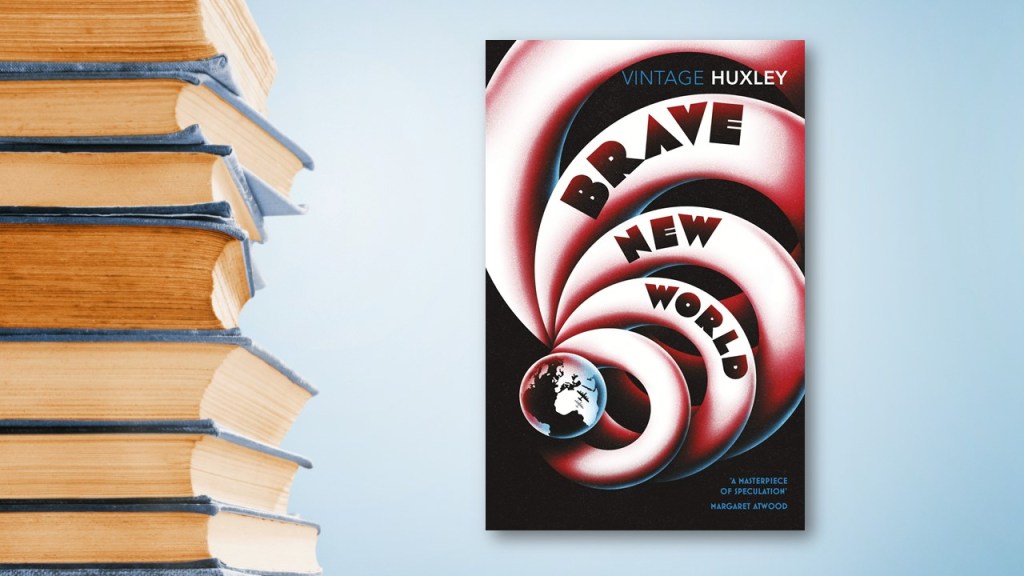
This was a book I requested for Christmas, and was kindly bought by my aunt and uncle. I knew very little about it – only that it was a classic dystopian work.
I was pleasantly surprised by the readability of it. The introductory material was heavy and academic; and when I learned from it that the book was written in 1931, I braced myself for perhaps difficult and outdated prose. I needn’t have been so prejudiced – the prose was compelling and carried me easily along.
It was a deeply uncomfortable read. The futuristic World State is theoretically incredibly advanced and well-justified. Everyone is “happy”: performing the roles in society for which they are best suited (as they have been conditioned for them), taking the drug “soma” to enhance their feelings of bliss, and enjoying every sensual pleasure, from fantastical music to complex sports to orgies. Monogamy is a thing of the distant past: “everyone belongs to everyone else”. No one need have any familial attachments, as babies are grown and raised in a factory. The society is based on consumption, with everything deliberately engineered to require ever new products (“ending is better than mending”, as the children are taught in their sleep) and thus keep the economy stimulated. Everyone is eternally youthful, healthy, entertained and replete.
It is the introduction of an external “Savage” which allows us to pinpoint why this self-professed utopia is in fact so dystopic. The Savage (raised on a reservation outside the World State) has found great joy in the works of Shakespeare, which has very much informed his outlook on life. On arriving in London, he is appalled at what he finds there: the lack of true feeling, the lack of art, the lack of individuality, the lack of moral code, the simpleness and childishness of all these people whose function is consumption and pleasure.
I read the end of the book sitting at the back of our church, my husband practising the organ. It was an appropriate setting for reading the Savage’s conversation about theology with the Resident World Controller of Western Europe. They discussed the writing of John Henry Newman (familiar to me as the namesake of my secondary school) and whether humanity can be independent of God. Their conversation about God and free will is well summarised in the discussion’s powerful conclusion:
“But I like the inconveniences.”
“We don’t,” said the Controller. “We prefer to do things comfortably.”
“But I don’t want comfort. I want God, I want poetry, I want real danger, I want freedom, I want goodness. I want sin.”
“In fact,” said Mustapha Mond, “you’re claiming the right to be unhappy. Not to mention the right to grow old and ugly and impotent; the right to have syphilis and cancer, the right to have too little to eat; the right to be lousy; the right to live in constant apprehension of what may happen tomorrow; the right to catch typhoid; the right to be tortured by unspeakable pains of every kind.” There was a long silence.
“I claim them all,” said the Savage at last.
Mustapha Mond shrugged his shoulders. “You’re welcome,” he said.
Brave New World – Aldous Huxley
I thought the book was brilliant and clever and incredibly thought-provoking. Its major failing, for me, was the portrayal of women. It is ironic that one character decries the way in which women are talked about as if they were meat, because the book as a whole doesn’t do much better. There are two significant female characters: Lenina, whose existence revolves solely around men and her sexual relationships with them, and Linda, a woman of the World State who was abandoned on the reservation where she gave birth to the Savage and then lost her former youth and beauty. The way that Linda is described, and even considered by her own son, is horrendous and misogynistic. The reader relies on the Savage to see the World State truthfully, and so his sexist disdain for his mother and his defamation of Lenina as a “whore” and “strumpet” (simply for being as “promiscuous” as her society has trained her to be) rings out of the book with an alarming legitimacy. It is women who drive the Savage to madness, whilst men engage him in intellectual discussion. For a book that was so clever in other ways, this portrayal is disappointingly crude.
Fahrenheit 451 – Ray Bradbury
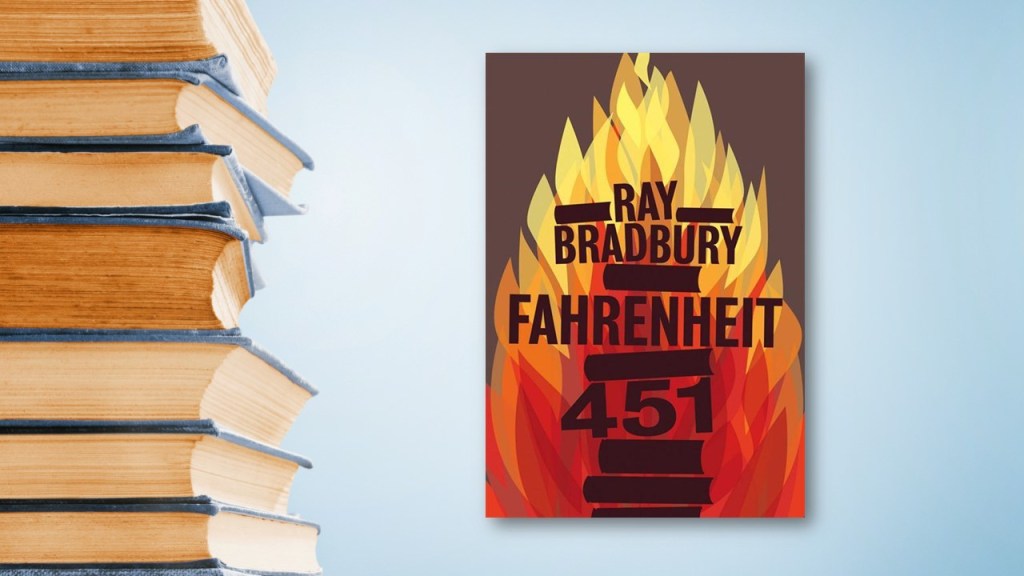
This is the other book I requested from my aunt and uncle for Christmas, again with almost no prior knowledge of it. Written in 1953, it tells the tale of a fireman in a future society whose job it is to destroy books, now illegal (Fahrenheit 451 is the burning point of paper).
It was extremely interesting to read this book straight after Brave New World and compare the dystopic visions. There were so many connections and thoughts that occurred to me, that I starting marking them with bookmarks, and when that became unmanageable, I marked them (shock horror) with pencil. I was reminded of the effect of soma and the lack of real emotion in Brave New World when the protagonist reflects on how numb he is. And I was reminded of the Savage’s yearning for individualism in Brave New World in this extract:
“Everyone must leave something behind when he dies, my grandfather said. A child or a book or a painting or a house or a wall built or a pair of shoes made. Or a garden planted. Something your hand touched some way so your soul has somewhere to go when you die, and when people look at that tree or that flower you planted, you’re there.”
Fahrenheit 451 – Ray Bradbury
And of his yearning for real freedom, as opposed to the World State’s stability, in this extract:
“Stuff your eyes with wonder,” he said, “live as if you’d drop dead in ten seconds. See the world. It’s more fantastic than any dream made or paid for in factories. Ask no guarantees, ask for no security, there never was such an animal. And if there were, it would be related to the great sloth which hangs upside down in a tree all day every day, sleeping its life away. To hell with that,” he said, “shake the tree and knock the great sloth down on his ass.”
Fahrenheit 451 – Ray Bradbury
This was another eminently readable and thought-provoking book. I think I like the dystopian genre!
The Ocean at the End of the Lane – Neil Gaiman
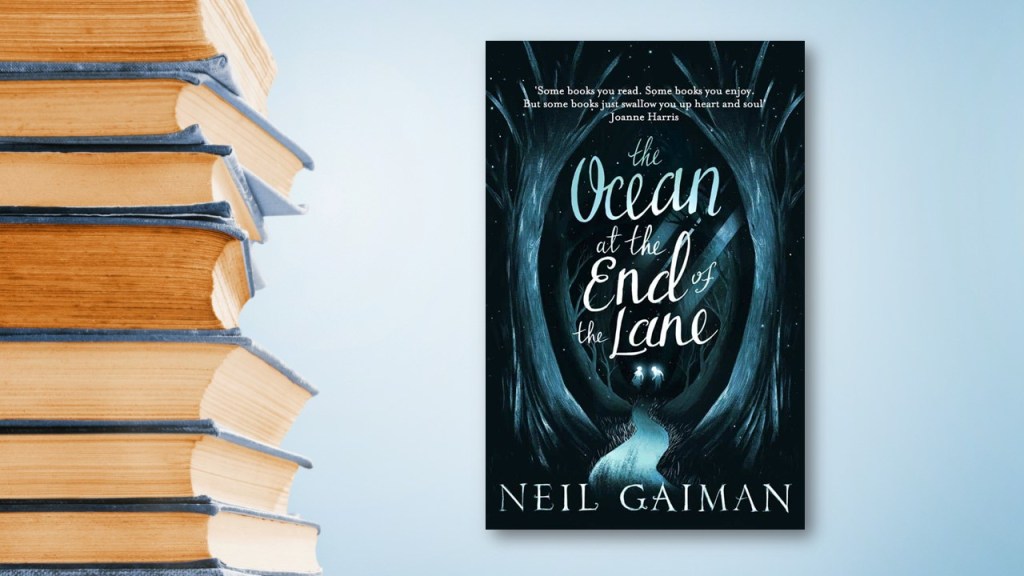
This was an e-reader daily deal that I picked up because I enjoyed Stardust by Neil Gaiman, and because we’ve booked to see The Ocean at the End of the Lane at the theatre in March.
What was most striking to me was that I have absolutely no idea how they’re going to perform this on stage. There’s a lot of magic: flying things and monsters and houses that change shape and ponds that become oceans… a lot of things that are difficult to imagine, let alone summon into being in a theatre. I’ll be fascinated to see it, and will have to come back here and add an update once I have done so.
Another thing that struck me was that I would have loved this book when I was teenager. I’m not quite so enamoured now. The book has some dark horror elements which would once have been like catnip to me, but no longer appeal. It’s interesting how our tastes can change over time.
Regardless, I still enjoyed the spell that Neil Gaiman cast, and was particularly impressed by his ability to evoke the experience of being a book-loving seven-year-old. The way the protagonist thinks is so genuinely and recognisably childlike, capturing things that I didn’t even remember about being a child, but felt so familiar.
I highlighted a few passages about childhood which I thought were particularly interesting.
The first was in the epigraph, for which he has chosen a quote by Maurice Sendak (probably most famously the author of Where the Wild Things Are):
I remember my own childhood vividly… I knew terrible things. But I knew I mustn’t let adults know I knew. It would scare them.
Maurice Sendak, in conversation with Art Spiegelman, The New Yorker, 27 September 1993
This reminded me of the idea of the “Gothic Child”: a particular fascination in literature with the idea of children who know too much, who defy the proper innocence of childhood with their improper adult knowledge. (I came across this idea recently in an episode of The Digital Human, which was talking about how very young children can have an uncanny knack for modern technology.)
I also liked:
Books were safer than other people anyway.
The Ocean at the End of the Lane – Neil Gaiman
This was a very familiar sentiment to me. And finally:
Adults follow paths. Children explore. Adults are content to walk the same way, hundreds of time, or thousands; perhaps it never occurs to adults to step off the paths, to creep beneath rhododendrons, to find the spaces between fences. I was a child, and I knew a dozen different ways of getting out of our property and into the lane,
The Ocean at the End of the Lane – Neil Gaiman
This reminded me of a concept in machine learning called “exploration vs exploitation”: the conundrum of how long an agent should spend exploring a problem and trying different things before it settles down to a consistent solution which exploits what it has learned in exploration. At some point between childhood and adulthood, we all move from exploration to exploitation.
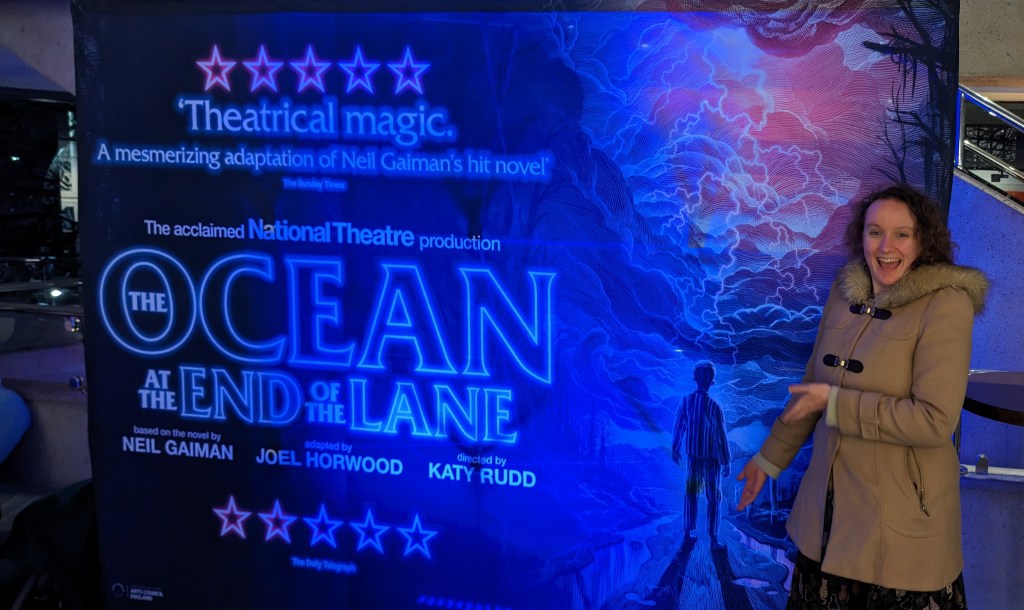
21st February edit: true to my word, I have come back to tell you about the play. It was visually extraordinary – the effects they used to achieve the magic were stunning (quite literally in some cases – there were some very shocking moments!), and the staging, the lighting, and the puppetry were all magnificent. But I was glad I had read the book, because otherwise I think I would have found it hard to grasp. And given that I picked up so strongly on the theme of childhood in the book, I was rather surprised to find an adult playing a 12-year-old (not 7-year-old) protagonist…
Our Missing Hearts – Celeste Ng
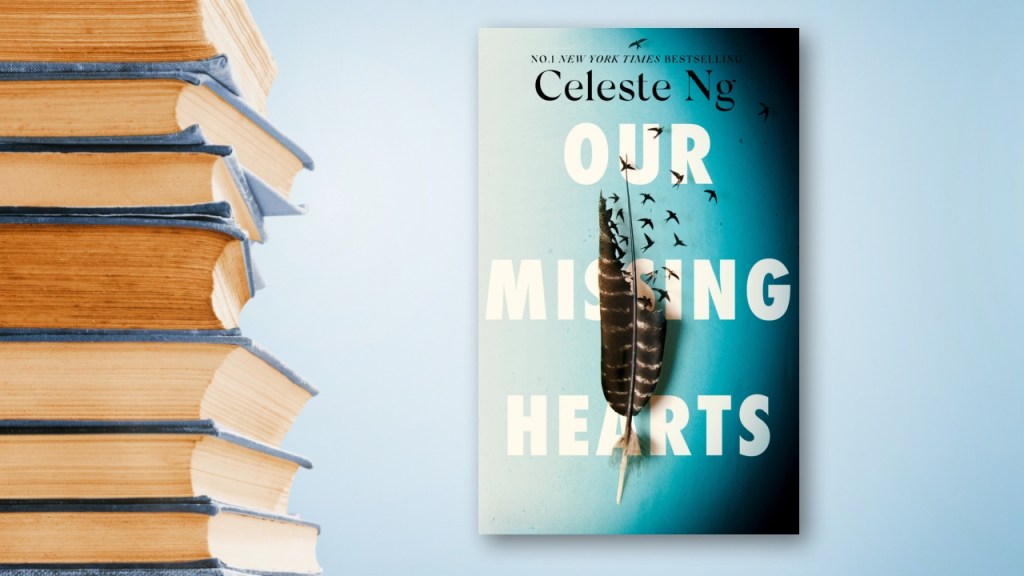
This was another e-reader daily deal, which I picked up because I so thoroughly enjoyed Little Fires Everywhere by Celeste Ng. I didn’t realise at the time that this was another dystopia!
The book is set in near-future America, after a “Crisis”. The Crisis was blamed on China, and so laws have been passed to “preserve American culture”. “Persons of Asian origin” are viewed with great suspicion, and the new laws allow children to be removed from homes that are considered a threat to recovering America. It’s horrifyingly believable. We are following the story of Bird, the teenage son of a poet who has written a poem which has inspired people protesting against the new laws.
I really enjoyed the book, though not quite as much as Little Fires Everywhere. I loved the writing style and the themes, but was a little unconvinced by the climax: it involved a certain amount of computer programming, my area of expertise (unfortunately for the author), and I found it rather unrealistic…
I was often reminded of Fahrenheit 451 in the themes of censorship, in passages like:
We don’t burn our books, she says. We pulp them. Much more civilized, right? Mask them up, recycle them into toilet paper. Those books wiped someone’s rear end a long time ago.
Our Missing Hearts – Celeste Ng
The scatological reference somehow seems even more brutal than the burning of books. And yet, just like in Fahrenheit 451, books can survive their destruction by being passed on in memory and oral tradition:
Somewhere out there are people who still know her poems, who’ve hidden scraps of them away in the folds of their minds before setting match to the papers in their hands.
Our Missing Hearts – Celeste Ng
I was also reminded a lot of Little Fires Everywhere in the theme of motherhood, and how complicated and nuanced a role it can be:
I’m not saying there aren’t bad mothers, she says. Just that you don’t always know. What makes them do something, or not do something. Most of us, we’re trying our best.
Our Missing Hearts – Celeste Ng
They settle on her with their dark wings then, nearly suffocating her: all of her many mistakes of motherhood.
Our Missing Hearts – Celeste Ng
Bird’s mother writes poetry about motherhood. She uses the symbol of a pomegranate, reflecting:
This was its job, she understood suddenly: to create all these seeds and then to explode.
Our Missing Hearts – Celeste Ng
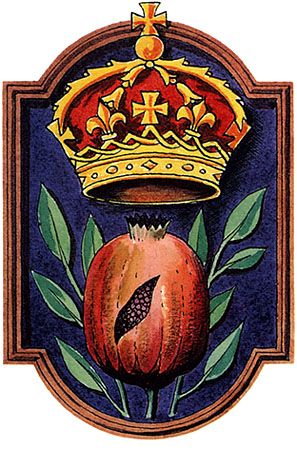
The pomegranate is a symbol with a long heritage. I have an interest in the Tudors, and was reminded that Catherine of Aragon used the device of a pomegranate, already an ancient symbol of fertility and regeneration. The message was that she would provide many heirs for Henry VIII. It was an ill-fated choice of device, as Catherine tragically lost many children in pregnancy and infancy, and had no surviving sons. The “job” was a particular burden to her.